
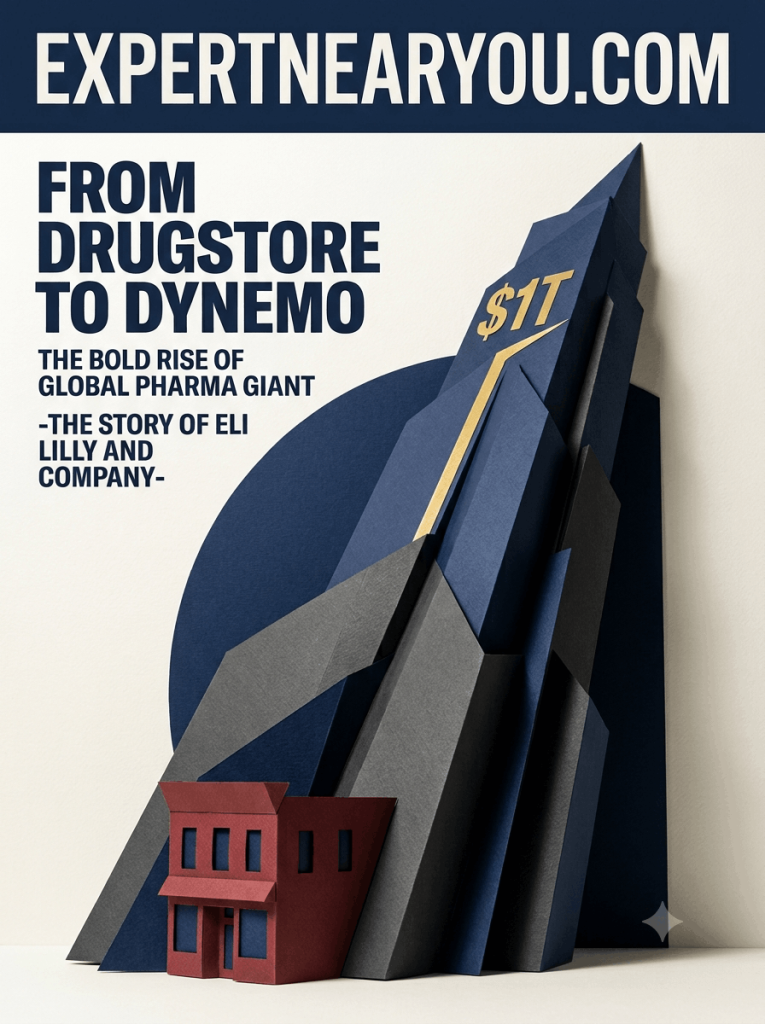
Inside Eli Lilly and Company: How a 150-Year-Old Indianapolis Drugmaker Became the World’s First Trillion-Dollar Pharmaceutical Company
Eli Lilly and Company Est. 1876
Other key leaders
- Dr. Daniel M. Skovronsky – Chief Scientific & Product Officer; President, Lilly Research Laboratories
- Jacob S. Van Naarden – EVP; President, Lilly Oncology & Head of Corp. Business Development
- Anat Hakim – EVP, General Counsel & Secretary
- Ilya Yuffa – EVP; President, Lilly USA & Global Customer Capabilities
prior estimate: ~$1.05T; real‑time fluctuates
Orforglipron (Foundayo™ – oral non‑peptide GLP‑1; submitted)
Humalog & Humulin (insulin therapies)
Inluriyo (breast cancer) · Jaypirca (blood cancers)
Omvoh (ulcerative colitis, Crohn’s) · Ebglyss (atopic dermatitis)
There is a particular kind of vertigo that comes from watching an old, familiar company suddenly become the most talked-about name in an entirely new conversation. For most of its history, Eli Lilly and Company was the kind of business that showed up in pharmacy aisles and diabetes clinics reliable, profitable, unglamorous. Then, within the span of a few years, it became something else entirely: the company behind the most culturally significant drugs of the decade, the subject of breathless investor coverage, and as of late 2025 the first pharmaceutical company in history to cross a $1 trillion market capitalization.
That milestone alone would be a notable business story. But the more interesting story is how a 150-year-old company built almost entirely on insulin, antidepressants, and antipsychotics found itself, in its 150th year, sitting at the center of the biggest metabolic health revolution in modern medicine. This is a look at how Eli Lilly got here, what’s actually driving the numbers, where the risks sit, and what the company’s own leadership believes comes next.
A Company Built on Firsts
Eli Lilly and Company was founded in 1876 by Colonel Eli Lilly, a Union Army veteran and pharmaceutical chemist who set up a small manufacturing operation in Indianapolis with a simple, almost old-fashioned premise: drugs should be made to a consistent, reliable standard, tested and verified rather than sold on faith. That founding principle rigor over folklore turns out to be a fairly accurate description of how the company has operated for a century and a half.
Lilly’s early history is dotted with genuine firsts, the kind that get referenced in medical history textbooks rather than corporate marketing materials. In the 1920s, following the discovery of insulin by Frederick Banting and Charles Best in Toronto, Lilly became the first company to commercially manufacture and distribute insulin at scale, marketed as Iletin. That single achievement is difficult to overstate: before mass-produced insulin, a type 1 diabetes diagnosis was, for most patients, a death sentence measured in months. Lilly’s manufacturing capability turned it into a chronic, manageable condition for millions of people.
Three decades later, in the 1950s, Lilly was among the primary manufacturers that mass-produced Jonas Salk’s original polio vaccine, playing a direct role in one of the most consequential public health campaigns of the twentieth century. Then, in 1982, the company introduced Humulin, the world’s first human insulin produced using recombinant DNA technology, rather than insulin extracted from animal pancreases. Humulin wasn’t just a manufacturing improvement; it was one of the first tangible proofs that biotechnology could produce medicines identical to the human body’s own molecules, a conceptual leap that underpins essentially the entire modern biologics industry.
That pattern being early and being right about a genuinely new category of medicine, is worth keeping in mind, because it’s essentially the same pattern that’s playing out again right now with GLP-1 receptor agonists.
The Company Today: Scale, Leadership, and a New Kind of Valuation
Eli Lilly and Company is headquartered in Indianapolis, Indiana, and today stands as the world’s most valuable pharmaceutical company by market capitalization. As of mid-2026, that valuation has fluctuated in a wide band, briefly crossing $1 trillion in late 2025, dipping into the $850–900 billion range during a broader market cooldown in early 2026, and climbing back above $1 trillion by summer, with some trackers placing it above $1.1 trillion in July 2026. The specific number moves week to week, as it does for any large-cap stock, but the underlying fact doesn’t: Lilly became the first healthcare company in history to reach a trillion-dollar valuation, joining a short list of companies, mostly technology giants like Apple, Microsoft, Nvidia, and Amazon that had previously been the only members of that club.
The company is led by David A. Ricks, who has served as Chairman and CEO since 2017 and is, by his own count, the eleventh chief executive in Lilly’s history. Ricks took the job at a genuinely difficult moment for the pharmaceutical industry’s public reputation a period when drug companies ranked below airlines and law firms in public trust, and when rising insulin costs were generating real, personal anger from patients rationing doses they couldn’t afford. Ricks has said that period, and the direct feedback he received from families struggling with insulin costs, shaped much of his subsequent strategy around pricing and access. Whether that strategy has fully addressed the underlying criticism is still very much a live debate, which this piece returns to later.
On the financial side, the scale of Lilly’s recent growth is difficult to overstate. The company generated $63.0–63.5 billion in revenue for full-year 2025 based on its own raised guidance, representing roughly 45% year-over-year growth an extraordinary growth rate for a company already operating at tens of billions of dollars in annual sales. Quarterly results have been similarly dramatic: fourth-quarter 2025 revenue reached $19.3 billion, up 43% year-over-year, while first-quarter 2026 revenue climbed to $19.8 billion, up more than 56% from the prior year. For 2026, the company has raised its full-year revenue guidance into the $82–85 billion range meaning Lilly is now projecting to grow revenue by roughly a third in a single year, a pace almost unheard of for a company already this large.
That growth has made Lilly one of the top handful of pharmaceutical companies in the world by both market value and revenue, sitting alongside long-established giants like Johnson & Johnson and Merck in most rankings, and ahead of nearly all of them in market capitalization.
The Engine Behind the Numbers: Tirzepatide and the Incretin Revolution
Almost all of that growth traces back to a single class of medicine: incretin-based therapies, and specifically tirzepatide, sold under two different brand names for two different purposes. Mounjaro is tirzepatide marketed for type 2 diabetes; Zepbound is the same molecule marketed for chronic weight management and, more recently, obstructive sleep apnea. Tirzepatide is a dual GLP-1/GIP receptor agonist meaning it activates two separate hormone receptor pathways involved in appetite regulation, insulin sensitivity, and blood sugar control, rather than the single GLP-1 pathway that older drugs like semaglutide rely on.
The commercial results have been staggering. Mounjaro and Zepbound together generated more than $36.5 billion in 2025, or over half of the company’s total revenue for the year. In the first quarter of 2026 alone, the combined franchise brought in $12.8 billion nearly two-thirds of the company’s total revenue for that quarter, with Mounjaro’s worldwide revenue alone jumping 125% year-over-year to $8.7 billion. Put simply: two drugs, sharing a single active ingredient, are now responsible for the majority of the world’s most valuable pharmaceutical company’s income.
That concentration is a genuine two-edged sword for the business, and serious analysts covering the stock treat it as such, a point this piece returns to in the section on risks.
Orforglipron: The Pill That Changes the Access Equation
Behind tirzepatide, Lilly’s next major growth driver is orforglipron, marketed under the brand name Foundayo. Orforglipron is notable less for its chemistry than for its form factor: it’s a daily oral, non-peptide GLP-1 medication for obesity, meaning patients take a pill rather than a weekly injection, and critically without the strict food and water restrictions around dosing that have made other oral GLP-1 attempts difficult to use in practice. If tirzepatide and semaglutide made injectable weight-loss treatment mainstream, an effective, easy-to-use oral GLP-1 has the potential to make it dramatically more accessible, since a meaningful share of patients are reluctant to self-inject or face supply and cost barriers with injectable pens. Lilly advanced orforglipron through multiple additional Phase 3 trials in 2025, enabling global obesity submissions by year’s end, and the drug has since moved toward approval and commercial launch.
Retatrutide: The Next-Generation “Triple G” Candidate
Sitting just behind orforglipron in the pipeline is retatrutide, Lilly’s most advanced experimental molecule and, by most measures, its most ambitious. Retatrutide is a triple hormone receptor agonist, activating GLP-1, GIP, and glucagon receptors simultaneously the first drug of its kind to reach late-stage clinical development. That third receptor, glucagon, is what has generated so much attention from researchers: unlike GLP-1 and GIP, which act mainly on appetite and gut motility, glucagon receptors act directly on the liver, prompting hepatocytes to burn stored fat and export lipids more efficiently.
In Phase 2 obesity trials, retatrutide produced weight loss of up to 24.2% at the highest dose over 48 weeks, a number that, at the time it was published, surpassed anything previously reported for either semaglutide or tirzepatide. A dedicated liver-disease substudy, published by Arun Sanyal and colleagues in Nature Medicine in 2024, found that participants with metabolic dysfunction-associated steatotic liver disease (MASLD), the current clinical term for fatty liver disease, saw liver fat reductions in the 80%+ range at higher doses, with the large majority of participants on the top dose falling entirely out of the diagnostic threshold for the disease.
Those Phase 2 results have carried retatrutide into an extensive Phase 3 program spanning three families of trials: one focused on obesity (TRIUMPH), one on type 2 diabetes (TRANSCEND), and a dedicated liver-disease program (SYNERGY) built around biopsy-confirmed MASLD/MASH outcomes rather than imaging alone. The first Phase 3 readout, TRIUMPH-4, reported in December 2025, showing 28.7% average weight loss at 68 weeks in patients with obesity and knee osteoarthritis, alongside a 75% reduction in osteoarthritis pain, an unusual and clinically meaningful secondary finding. A second major readout, the pivotal TRIUMPH obesity trial, posted topline results in May 2026 showing 28.3% mean weight loss at 12 mg over 80 weeks. Roughly half a dozen additional Phase 3 readouts are expected across the retatrutide program before the end of 2026, spanning diabetes, sleep apnea, chronic low back pain, and cardiovascular and liver outcomes.
Retatrutide is not yet approved anywhere in the world, and Lilly’s own regulatory timeline points to a New Drug Application submission in the Q4 2026 to Q1 2027 window, with realistic approval, assuming a standard review timeline, landing sometime in late 2027 or 2028. Analysts nonetheless already treat it as one of the most important assets in Lilly’s pipeline, both because of its efficacy data and because a successful liver-disease indication would put Lilly in a category, dedicated MASLD/MASH treatment that very few other companies have credibly entered.
Beyond the Scale: Oncology, Neuroscience, and the Legacy Business
It’s easy, given the sheer size of the metabolic franchise, to lose sight of the fact that Lilly still runs a substantial and diversified pharmaceutical business outside of GLP-1 drugs.
In oncology, Verzenio (abemaciclib) remains a significant contributor, used in the treatment of advanced and early-stage breast cancer, and accounting for roughly 9% of total company revenue on its own, a meaningful business by the standards of almost any other pharmaceutical company, even if it’s now a comparatively small slice of Lilly’s total.
In neuroscience, Kisunla (donanemab) represents Lilly’s entry into the small and difficult category of disease-modifying Alzheimer’s treatments, targeting amyloid plaques believed to drive the disease’s progression. This is a notoriously hard therapeutic area, decades of Alzheimer’s drug development have produced far more failures than successes, and Kisunla’s approval places Lilly among a very small number of companies with an approved amyloid-targeting therapy on the market.
The company’s immunology portfolio includes Taltz, used for plaque psoriasis and related inflammatory conditions, and Olumiant, a JAK-inhibitor used for rheumatoid arthritis and other autoimmune conditions. Neither generates headlines the way the obesity franchise does, but both represent durable, profitable businesses in therapeutic areas where Lilly has built long-standing physician relationships.
Finally, there’s the legacy portfolio, the drugs that built Lilly’s twentieth-century reputation and have since gone generic. Prozac reshaped how the American public understood and talked about depression treatment when it launched in the late 1980s. Zyprexa became a mainstay antipsychotic for schizophrenia and bipolar disorder. Cymbalta addressed both depression and chronic pain conditions. All three are now off-patent and generate a fraction of their former revenue, but they remain part of the institutional identity of a company that, at various points over the last forty years, has quite literally changed how mental illness is treated and discussed in mainstream culture.
The R&D Engine: Betting Billions on the Next Decade
Underneath the commercial story is a research and development operation of genuinely enormous scale. Lilly spent $13.3 billion on R&D in 2025, roughly 20.5% of total sales, and R&D spending has continued to climb through 2026, with quarterly R&D expenses running in the $3.5–3.8 billion range and increasing by roughly a quarter year-over-year in recent quarters. Approximately 12,500 of Lilly’s employees, or nearly a quarter of its total global workforce, are directly engaged in research and development activities, working across R&D facilities in eight countries and running clinical trials in more than 55 countries worldwide.
That spending reflects the brutal economics of drug development generally: Lilly cites an average cost of roughly $2.6 billion to discover and develop a single new drug, with an average timeline of about ten years from initial discovery to a medicine actually reaching a patient. Against that backdrop, the company’s late-stage pipeline has been unusually productive recently, more than 25 Phase 3 trials produced positive topline results in 2025 alone, including registrational studies for both orforglipron and retatrutide, and the company started 12 new Phase 3 programs across therapeutic areas including cardiovascular disease and non-small cell lung cancer.
Lilly has also begun explicitly positioning artificial intelligence as a core part of its future R&D strategy, rather than a peripheral experiment. In 2026, the company unveiled a supercomputer built in partnership with Nvidia, designed to help researchers process large-scale biological datasets and accelerate drug discovery, alongside a $1 billion joint laboratory in San Francisco. CEO David Ricks has framed this as a genuine competitive advantage rooted in proprietary data rather than just computing power, noting that while many newer “tech-bio” companies are training AI models largely on publicly available data, Lilly’s own internal archive includes data from more than 3 million failed drug candidates, compared to roughly 4,000 drugs that have ever been approved across the entire industry. That failure data, Ricks argues, may ultimately be as valuable to an AI-assisted discovery process as knowledge of what worked, since it maps the far larger space of what doesn’t.
Building the Factories: A $50 Billion Manufacturing Bet
Scientific breakthroughs are only useful if a company can actually manufacture enough of the resulting drug to meet demand and demand for GLP-1 medications has, at various points over the last several years, badly outstripped supply across the entire industry, Lilly included. In response, the company has embarked on one of the largest manufacturing capital expenditure programs in pharmaceutical industry history.
Since 2020, Lilly has committed more than $55 billion to manufacturing investments, and in 2025 alone the company doubled down further, announcing plans for four new U.S. manufacturing sites and pushing its total domestic capital expansion commitments since 2020 above $50 billion. Three of the newly announced U.S. sites are focused on manufacturing active pharmaceutical ingredients, effectively reshoring small-molecule chemical synthesis capability that much of the industry had offshored over previous decades while a fourth extends Lilly’s global network for manufacturing injectable therapies. The company expects these new sites to create more than 3,000 highly skilled permanent jobs, alongside roughly 10,000 construction jobs during the build-out phase.
Individual site announcements throughout 2025 and into 2026 illustrate the scale of the buildout: a $6.5 billion expansion of a manufacturing facility at Generation Park in Houston, Texas; a $4.5 billion investment expanding sites in Lebanon, Indiana, to support weight-loss drug and genetic therapy manufacturing; new capacity commitments in Alabama, Pennsylvania, Virginia, and the Netherlands; new production coming online at sites in Wisconsin and North Carolina; and continued construction of the Lilly Medicine Foundry in the company’s home state of Indiana. Actual capital expenditures reflect that pace: Lilly spent $7.8 billion on capital investment in 2025 alone, up from $5.1 billion in 2024.
Globally, the company now manufactures and distributes its products through facilities located across the United States (including Puerto Rico), Europe, and Asia, with manufacturing plants in 10 countries and products marketed in approximately 90 countries worldwide.
A Global Workforce, A Global Footprint
As of late September 2025, Lilly employed just over 50,000 people worldwide, roughly 23,500 in the United States and 26,500 outside the U.S., reflecting a workforce that is now, on balance, more international than domestic. That’s a notable shift for a company still closely associated with a single American city, and it reflects both the global reach of its clinical trial and manufacturing operations and the international scale of the obesity and diabetes markets it now serves.
The Other Side of the Ledger: Pricing Controversy and Legal Battles
No honest account of Lilly’s current position can skip over the legal and political pressure the company is facing, much of it directly connected to the same drugs driving its growth.
The most longstanding controversy involves insulin pricing. Despite insulin costing Lilly only a few dollars per vial to manufacture, list prices for some of the company’s insulin products have run between roughly $300 and $700, and insulin prices industry-wide have risen by more than 1,000% over the past two decades according to multiple ongoing lawsuits. In late December 2025, Indiana’s own attorney general, Todd Rokita, filed a lawsuit against Lilly an Indiana-headquartered company alleging a coordinated price-fixing scheme involving secret rebates paid to pharmacy benefit managers in exchange for favorable placement on drug formularies, artificially inflating list prices in the process. That lawsuit builds on a much larger web of litigation: as of mid-2025, more than 400 lawsuits were pending in a consolidated multi-district litigation in New Jersey covering insulin pricing across Lilly, Novo Nordisk, Sanofi, and major pharmacy benefit managers, with individual cities, counties, and school districts also filing their own suits over what they characterize as decades of coordinated price inflation. Lilly has consistently disputed these characterizations, pointing to its $35-per-month insulin out-of-pocket cost cap and a 70% cut to certain insulin list prices as evidence of what it describes as industry-leading affordability efforts.
A newer and, in some ways, more complicated legal front has opened around compounding pharmacies. During periods when Mounjaro and Zepbound were in short supply, federal law allowed compounding pharmacies to legally produce compounded versions of tirzepatide to fill the gap. As branded supply has caught up with demand, Lilly has moved aggressively to shut that practice down, filing lawsuits beginning in early 2025 against compounding pharmacies including Empower Pharmacy and Strive Pharmacy, alleging they were selling unauthorized “knockoff” versions of its obesity and diabetes drugs after the shortage designation should have lapsed. Legal analysts have described this as the opening wave of what could become dozens of similar lawsuits as Lilly works to protect its branded market share. Compounders have pushed back hard: Strive Pharmacy has separately sued both Lilly and Novo Nordisk, alleging the two companies are coordinating to suppress competition and unlawfully limit patient access to compounded GLP-1 medications a dispute that captures, in miniature, the broader tension between protecting a hugely profitable branded franchise and the argument that patients deserve cheaper alternatives to genuinely life-changing medication.
Together, these controversies point to a structural challenge that shadows Lilly’s entire growth story: a company whose most valuable products are also, for a meaningful share of patients, unaffordable without insurance coverage or assistance programs a tension that isn’t likely to resolve cleanly regardless of how the litigation shakes out.
Corporate Responsibility and Global Health Commitments
Set against that legal backdrop, Lilly has also built a genuinely long-running philanthropic and global health program, much of it specifically targeted at the affordability and access gaps critics point to. Since 2009, the company has donated more than 8.1 million vials and cartridges of insulin through the Life for a Child program, which supports children with type 1 diabetes in lower-income countries where insulin access is often severely limited. Through a partnership called AMPATH, Lilly has supported breast and cervical cancer screening for nearly 200,000 people in Kenya. Over more than a century, Lilly employees, retirees, and the Lilly Foundation have collectively contributed more than $300 million to United Way campaigns, and the company’s Global Day of Service initiative has generated more than 1 million employee volunteer hours since it began in 2008.
More recently, the company has also worked on structural access initiatives closer to home, including a 2025 agreement to broaden availability of its obesity medicines through Medicare and participating state Medicaid programs, alongside direct-to-patient sales models like LillyDirect, designed to let patients purchase certain medications directly rather than solely through traditional insurance and pharmacy channels.
Investor Perspective: A Premium Valuation With Real Concentration Risk
From a pure markets standpoint, Lilly’s stock has been one of the standout performers of the mid-2020s, up more than 40% over trailing twelve-month periods at various points through 2026 and trading at a meaningful premium to both its large-cap pharmaceutical peers and the broader S&P 500 roughly 30 times forward earnings at points during the year, compared to an industry average closer to 18 times. Analysts covering the stock generally credit that premium to three factors: the sheer size of the addressable GLP-1 market, which some estimates suggest could eventually generate more than $150 billion annually worldwide across all competitors; Lilly’s demonstrated ability to convert its cash flow into acquisitions of promising pipeline assets, including a $3.83 billion spree in May 2026 covering three biotech acquisitions spanning vaccine candidates for shingles and surgical-site infections; and the increasing contribution of high-margin specialty medicines to the overall revenue mix.
That said, the same analysts are candid about the risks embedded in that valuation. Revenue concentration is the most obvious one: with roughly two-thirds of quarterly revenue now tied to a single molecule sold under two brand names, any meaningful pricing pressure, safety signal, or competitive disruption to tirzepatide would have an outsized effect on the entire company’s financial profile in a way that wasn’t true even five years ago, when Lilly’s revenue base was far more diversified. Competition from Novo Nordisk whose own GLP-1 franchise, built around semaglutide, remains the closest rival to Lilly’s incretin portfolio represents a second structural risk, as does the broader possibility of increased regulatory scrutiny or government pricing intervention aimed specifically at the obesity drug category, given how visible and politically salient GLP-1 pricing has become. Manufacturing execution risk is a third: a company attempting to bring dozens of new manufacturing sites online simultaneously, across multiple countries, inevitably faces some probability of delays, cost overruns, or quality issues along the way.
None of that has meaningfully dented investor enthusiasm so far, but it’s the honest counterweight to a growth story that, on the surface, looks almost uninterrupted.
What Comes Next?
Lilly enters the back half of its 150th anniversary year with arguably the deepest and most consequential late-stage pipeline in its history. Orforglipron is moving toward global commercial launch as the first genuinely convenient oral GLP-1 option, with the potential to open the obesity treatment market to millions of patients who have been reluctant to start injectable therapy. Retatrutide’s Phase 3 program is expected to generate roughly half a dozen more readouts before the end of 2026, any one of which could materially move the stock, and its dedicated liver-disease program represents a genuine attempt to become the first company with an approved medicine specifically indicated for MASLD/MASH rather than obesity alone. Beyond the incretin franchise, newer cardiovascular and oncology candidates like muvalaplin and olomorasib are advancing through their own Phase 3 programs, suggesting the company is trying deliberately, not to let its identity collapse entirely into “the GLP-1 company,” even as GLP-1 drugs currently generate the overwhelming majority of its revenue.
At the same time, the unresolved insulin pricing litigation, the escalating legal fight with compounding pharmacies, and the underlying question of long-term drug affordability in the U.S. healthcare system aren’t going away, and they represent exactly the kind of slow-burning reputational and regulatory risk that has derailed pharmaceutical giants before.
What’s clear, regardless of how those threads resolve, is that Eli Lilly’s current moment is genuinely historic, not just for the company, but for the pharmaceutical industry as a whole. A 150-year-old insulin manufacturer becoming the world’s most valuable healthcare company, on the strength of a molecule that didn’t exist a decade ago, is the kind of transformation that doesn’t happen often in an industry built around decade-long product cycles and patent walls. Whether Lilly can sustain that position, through patent expirations, competitive pressure from Novo Nordisk and emerging challengers, and a political environment increasingly focused on drug pricing is the question that will define the company’s next chapter as clearly as insulin defined its first.
Disclaimer: This article reflects publicly reported financial data, clinical trial results, and news coverage as of mid-2026. Figures such as market capitalization and stock valuation fluctuate continuously and are accurate as of the reporting dates cited. This piece is intended for informational and business-journalism purposes and does not constitute investment advice.
